Beautiful Thinking.
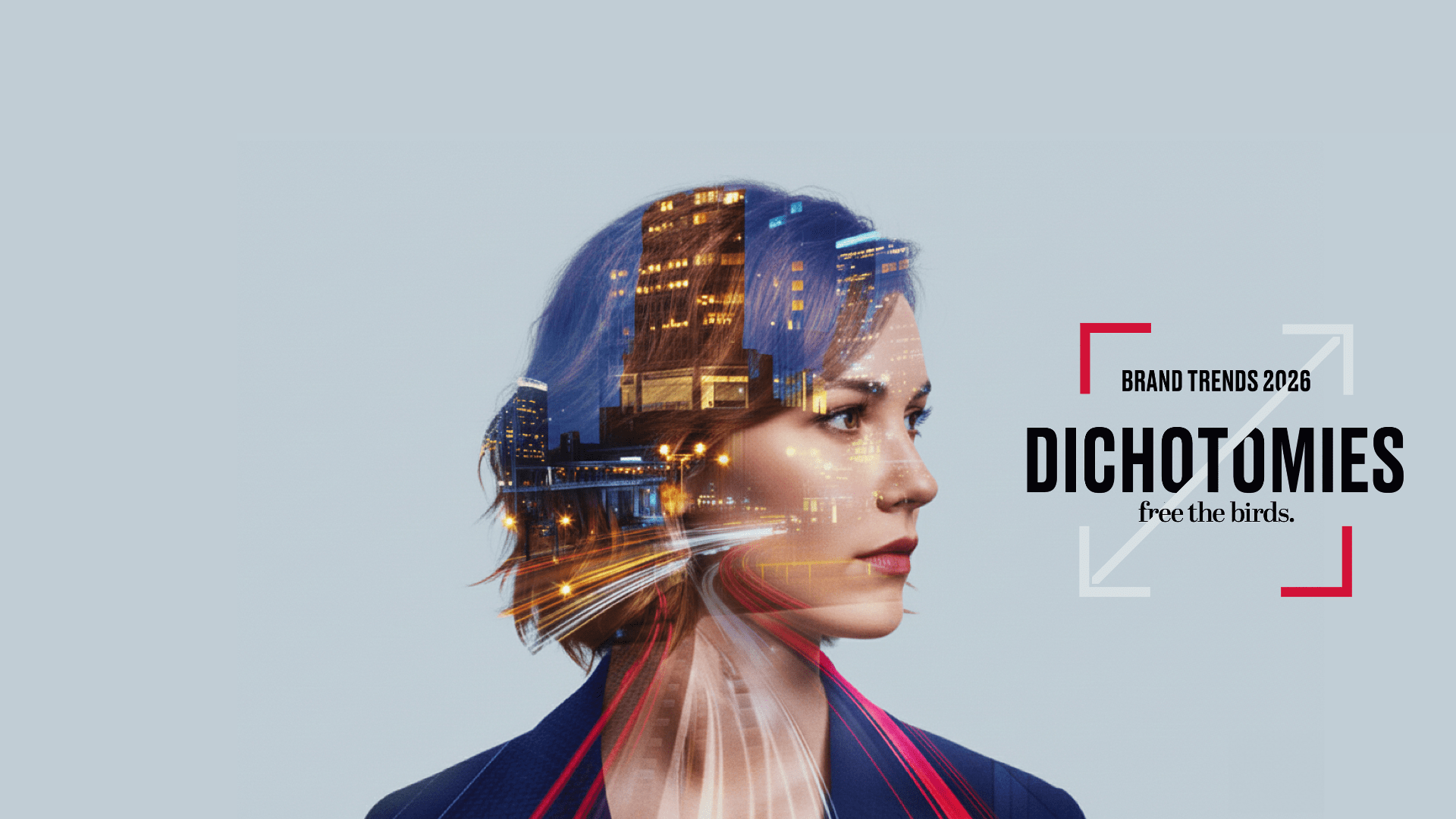
As we approach 2026, the beauty, health, and wellness sectors are not only navigating shifts in consumer preferences but are also facing broader societal changes that have fundamentally reshaped how people view themselves, their role in society and how they present themselves to it, and their future.
These shifts are evident in the trends we are witnessing today – a marked divergence between two opposing consumer camps, each driven by unique motivations and reflective of larger global dynamics.
In recent years, the world has been marked by profound political, economic, and social upheaval. And these tensions have inevitably trickled down into consumer choices, especially as brands grapple with increasingly polarised markets.
It is a movement which is fundamentally shifting the ways in which consumers and brands interact, and is driving these businesses to consider their position in what we are calling the dichotomy of consumer trends.
And if brands aren’t recognising these influential dichotomies, and maintaining an attempt to sit on the fence and cater to these opposing sides, they will unfortunately suffer the consequences.
The dichotomy of not only the values we align ourselves to, but also the situations and aspirations of consumers across the globe, is now becoming mirrored in the products we purchase and the brands we engage with. On one hand, we have brands rising on the wings of ultra-luxury, exclusivity, and aspiration, a beacon for those who feel empowered by wealth, and have the financial capabilities and disposable income to meet their own personal standard.
On the other hand, there’s a swelling wave of value-driven, inclusivity-focused brands that emphasise accessibility, social consciousness, and community – as well as, of course, a financial need to seek value. This stark contrast is no longer confined to abstract societal discussions – it is manifesting in the very products consumers buy.
More than ever, consumers are aware of their place within this divide, which is leading to a bifurcation of market segments. What once was a subtle undercurrent is now a visible rift, echoing in our branding strategies and product designs.
As branding experts, we are acutely aware that these broader global tensions have not just shaped consumer behaviour but have also influenced the very fundamentals of creative decision-making. We see it in the rise of two opposing design languages. On one hand, brands that embody eclectic, maximalist aesthetics, tapping into a deep sense of individuality, local heritage, and even rebellion against homogenised culture. On the other, we see brands leaning into the cool minimalism that speaks to a desire for peace, control, and refinement, a reflection of those who find comfort in simplicity amidst global chaos.
This is not just about trends. We are at a pivotal moment in the evolution of consumer culture, and these dichotomies are a direct response to the world we live in, where opposing forces are playing out not only on the global stage, but in our very consumer choices.
Adding to the cultural differences we are witnessing, the role of artificial intelligence (AI) in branding and marketing is rapidly becoming another significant point of competition. Some brands are embracing AI at full speed, using its capabilities to scale their marketing efforts, enhance creative output, and produce cost-effective content.
On the other hand, a growing counter-movement of brands is pushing back against AI, aligning themselves with consumers who prioritise human touch, transparency, and a sense of connection in a world where everything seems automated.
This divide between AI-driven efficiency and authenticity is particularly relevant in the beauty industry, where the tide is turning. Brands are facing a critical question, how much of their marketing content is genuinely authentic? Are we approaching a future where AI’s role in marketing must be transparent and complement, rather than replace, authentic human experience? Ultimately, a brand must make crystal clear what their relationship with AI is, and run with it.
As with all opposing views, we see growth in both areas. The dichotomies of luxury versus value, AI-driven efficiency versus authenticity, eclectic design versus minimalism, are not trends that can be ignored. They are rapidly defining the future of consumer brands in beauty, health, and wellness. There is no room to sit on the fence anymore. The market is demanding clarity and alignment.
It is some of these key points of differentiation which are fuelling the predictions our creative team are making for the future of key industries in 2026, and beyond.
The call to action based on these trends, to be revealed in the weeks ahead, is that in this world increasingly shaped by polarised perspectives, brands must take a stand.
Whether embracing the speed and innovation of AI, championing human authenticity, or navigating the tensions between global and local values, the time to defend your corner is now. The choices are clear. Brands that align themselves with one side of the spectrum and speak confidently to their audience will rise, while those that attempt to balance both will struggle to find their place.
It is a moment of great opportunity, but only for those brave enough to make bold decisions. In the end, those who understand and embrace the dichotomies that shape the world today will lead the way forward.
Stay tuned for how we see significant trends in product innovation, brand expression, and consumer experience evolving as these divides continue to shape the market.